Linking words are an important part of IELTS Writing because they help connect ideas, sentences, and paragraphs in a clear and logical way. Whether you are preparing for IELTS Academic or IELTS General Training, using linking words correctly can make your writing easier to understand and improve the overall flow of your ideas.
However, using too many linking words—or using them incorrectly—can make your writing sound unnatural. The goal is not to use a linking word in every sentence, but to use the right connector at the right place.
In this guide, we will explore what linking words are, the different types you can use in IELTS Writing, common mistakes, and practical tips to use them effectively.
What Are Linking Words?
Linking words, also called connectors, transition words, or cohesive devices, are words and phrases used to connect ideas.
For example:
Many students choose to study abroad. However, studying in another country can be expensive.
The word “however” shows a contrast between the two ideas.
In IELTS Writing, these connections help the examiner understand how your ideas relate to each other.
Why Are Linking Words Important in IELTS Writing?
One of the IELTS Writing assessment criteria is Coherence and Cohesion. This relates to how logically your ideas are organised and how effectively you connect different parts of your response.
Appropriate linking words can help you:
- Connect related ideas
- Introduce contrasting opinions
- Explain causes and effects
- Give examples
- Add supporting information
- Organise arguments
- Draw conclusions
- Improve the overall flow of your writing
For example, compare these two sentences:
Without linking words:
Many people work from home. They save commuting time. They may also have a better work-life balance.
With appropriate linking:
Many people work from home. As a result, they can save commuting time and may also achieve a better work-life balance.
The second version makes the relationship between the ideas clearer.
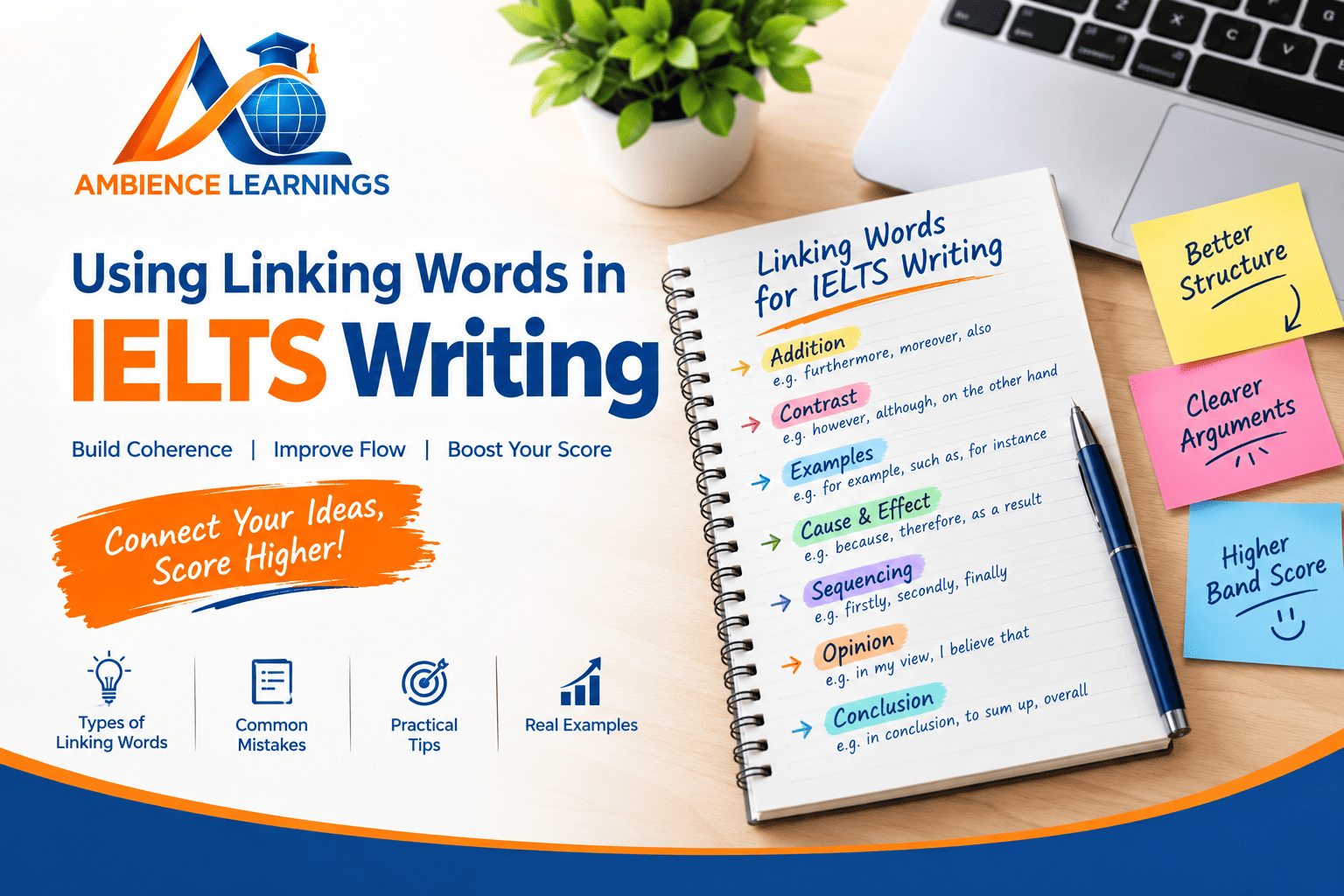
Types of Linking Words for IELTS Writing
Different linking words have different purposes. Understanding these purposes is more important than simply memorising long lists.
1. Adding Information
Use these linking words when you want to introduce another related idea.
Examples:
- Additionally
- Furthermore
- Moreover
- In addition
- Also
- Besides
Example:
Public transport can reduce traffic congestion. Additionally, it can help lower pollution in large cities.
IELTS Tip
Avoid using “Moreover” or “Furthermore” repeatedly. Simple connectors such as “also” and “in addition” can sound more natural when used appropriately.
2. Showing Contrast
Contrast linking words are particularly useful when discussing two different opinions, situations, or arguments.
Examples:
- However
- Nevertheless
- On the other hand
- In contrast
- Whereas
- While
- Although
- Despite this
Example:
Living in a large city provides many employment opportunities. However, the cost of living can be considerably higher.
You can also use “although” within a sentence:
3. Giving Examples
Examples are extremely useful in IELTS Writing because they can help explain and support your main ideas.
Useful expressions include:
- For example
- For instance
- Such as
- To illustrate
- A good example of this is
Example:
Technology has transformed the way people communicate. For example, video conferencing allows employees to communicate with colleagues in different countries.
Try to make your examples relevant to the argument rather than adding examples simply to increase your word count.
4. Showing Cause and Effect
Cause-and-effect relationships are common in IELTS essays.
Cause connectors:
- Because
- Since
- Due to
- Owing to
- As a result of
Effect connectors:
- Therefore
- Consequently
- As a result
- Thus
- Hence
Example:
Many people are moving to urban areas because cities offer more employment opportunities.
5. Sequencing Ideas
Sequencing words are useful when explaining a process, presenting several points, or organising information.
Examples:
- Firstly
- First of all
- Secondly
- Finally
- Subsequently
- Initially
- In the first place
For example:
Firstly, governments should invest in public transport. Secondly, they should improve cycling and walking infrastructure. Finally, they should encourage people to use environmentally friendly forms of transport.
However, you do not always need to use firstly, secondly, thirdly. Good paragraph organisation and topic sentences can often create a logical structure without repeatedly using these words.
6. Giving Your Opinion
In IELTS Writing Task 2, you may need to clearly present your opinion.
Useful expressions include:
- In my opinion
- In my view
- I believe that
- From my perspective
- It seems to me that
For example:
In my view, governments should invest more heavily in public transport rather than expanding roads for private vehicles.
However, avoid using opinion phrases in every paragraph. Once your position is clear, you can develop your arguments directly.
7. Drawing a Conclusion
A conclusion should summarise your main position or the key points discussed in your essay.
Useful linking expressions include:
- In conclusion
- To conclude
- Overall
- In summary
- Taking everything into consideration
Example:
In conclusion, although technology has created new opportunities for education, traditional classroom learning continues to provide important benefits.
A conclusion should not normally introduce a completely new argument.
Common Mistakes with Linking Words
Using linking words does not automatically improve your IELTS score. Accuracy and appropriateness are more important than quantity.
1. Using Too Many Linking Words
Some candidates put a connector at the beginning of almost every sentence:
Firstly, technology is useful. Secondly, it is convenient. Moreover, it is affordable. Furthermore, it saves time. Therefore, people use it widely.
This can sound mechanical and repetitive.
Instead, combine ideas naturally and use connectors only where they improve clarity.
2. Using the Wrong Connector
Make sure the relationship between your ideas matches the connector.
For example:
Many people enjoy online shopping. Therefore, traditional shops are still popular.
This is incorrect because “therefore” indicates a result, while the second sentence presents a contrasting idea.
A better version would be:
Many people enjoy online shopping. However, traditional shops are still popular.
3. Repeating the Same Words
Using “however” five or six times in one essay can make your writing repetitive.
Try to vary your structures where appropriate:
- However…
- On the other hand…
- In contrast…
- Although…
But remember: variation should never come at the expense of accuracy.
How to Use Linking Words Naturally
The best approach is to focus on the relationship between your ideas rather than memorising a fixed list.
Before using a linking word, ask:
What is the relationship between these ideas?
- Is the second idea adding information?
- Is it contrasting with the first?
- Is it an example?
- Is it a result?
- Is it explaining a cause?
- Is it showing a sequence?
Once you identify the relationship, choose a suitable connector.
Also, remember that pronouns, repetition of key terms, synonyms, paragraph structure, and sentence structure can create cohesion too. You do not need a linking word between every sentence.
Final Tips for IELTS Candidates
To use linking words effectively in IELTS Writing:
- Learn linking words by function, not just as a memorised list.
- Use them when they make the relationship between ideas clearer.
- Avoid starting every sentence with a connector.
- Vary your linking words naturally.
- Check the grammar that follows each connector.
- Use examples to support your arguments.
- Focus on logical paragraph organisation.
- Do not use complicated connectors simply to appear advanced.
- Read your essay after writing and remove unnecessary connectors.
- Practise using linking words in complete sentences and paragraphs.
Conclusion
Linking words are an important tool for creating clear and well-organised IELTS Writing responses. They can help you show relationships between ideas, develop arguments, introduce examples, explain causes and effects, and create smoother transitions between different parts of your essay.
However, more linking words do not necessarily mean a better IELTS score. Effective writing depends on using cohesive devices accurately, naturally, and appropriately.
The key is simple: connect your ideas clearly, organise your paragraphs logically, and use linking words only when they genuinely improve the flow of your writing.
With regular practice, you can make linking words a natural part of your IELTS writing and develop essays that are clearer, more organised, and easier for the examiner to follow.